

TL;DR — Gel polish lasts longer on paper — 14 to 21 days versus 7 to 10 days for nail wraps like ManicureFX. But raw wear time isn't the full story. Gel requires a UV lamp, 45+ minutes of application, and acetone removal that thins your nail plate. Nail wraps apply in 15 minutes with no drying, no lamp, and peel off cleanly. The winner depends on your lifestyle, budget, and how much you value your natural nails.
What's the actual difference between nail wraps and gel polish?
Nail wraps and gel polish are two completely different manicure technologies that happen to deliver similar-looking results. Nail wraps are thin, pre-designed adhesive strips made with real nail polish ingredients — you peel them off a backing sheet, press them onto a clean nail, file off the excess, and you're done. ManicureFX wraps require no drying time, no UV lamp, and no top coat to set.
Gel polish is a liquid formula painted on like regular polish, but it stays wet until you cure it under a UV or LED lamp. Each layer — base coat, two color coats, top coat — needs 30 to 60 seconds of curing before the next goes on. The chemistry is photo-initiated polymerization: light triggers the gel to harden into a plasticky shell that bonds tightly to the nail plate. The U.S. FDA classifies UV nail curing lamps as low-risk, though repeated long-term exposure is still being studied.
The biggest practical gap: design variety. Gel polish gives you solid colors out of the bottle, and any pattern — French tips, florals, glitter gradients — requires manual nail art skill or a separate appliqué. Wraps come pre-designed. A set like Botanical Garden or Gold French Tips puts salon-level art on your nails in 15 minutes without a single brush stroke.
How long do nail wraps actually last compared to gel polish?
Gel polish wins on pure wear time, lasting 14 to 21 days when applied correctly, while quality nail wraps last 7 to 10 days. That gap exists because cured gel forms a hard, chemically bonded shell, while wraps rely on adhesive that loosens with daily wear.
Real wear time depends on what you do with your hands. Hot water, dish soap, cuticle oils, and lotions all break down adhesives faster. Frequent hand washing — common for nurses, teachers, and parents — can shorten wrap wear to 5 to 6 days and trim gel down to 10 to 12 days. Nail growth also matters: by day 10, you'll see roughly 1 mm of regrowth at the cuticle regardless of which product you used.
Application technique closes the gap more than people expect. Sealing the free edge — running the wrap or gel over the tip of the nail and underneath slightly — adds 2 to 3 days of wear to wraps and prevents lifting on gel. Skipping cuticle oil for 24 hours after application also helps the adhesive set.
Quality matters too. Cheap PVC stickers from drugstores often peel within 3 to 4 days because they're plastic with weak adhesive. ManicureFX wraps are made with real nail polish ingredients, which is why a set like Midnight Bloom holds the full 7 to 10 days. If you want even longer wear, the Mint Whisper Gel wraps cure under a lamp like traditional gel and push wear time closer to two weeks.
How much does each option cost per manicure in Canada?
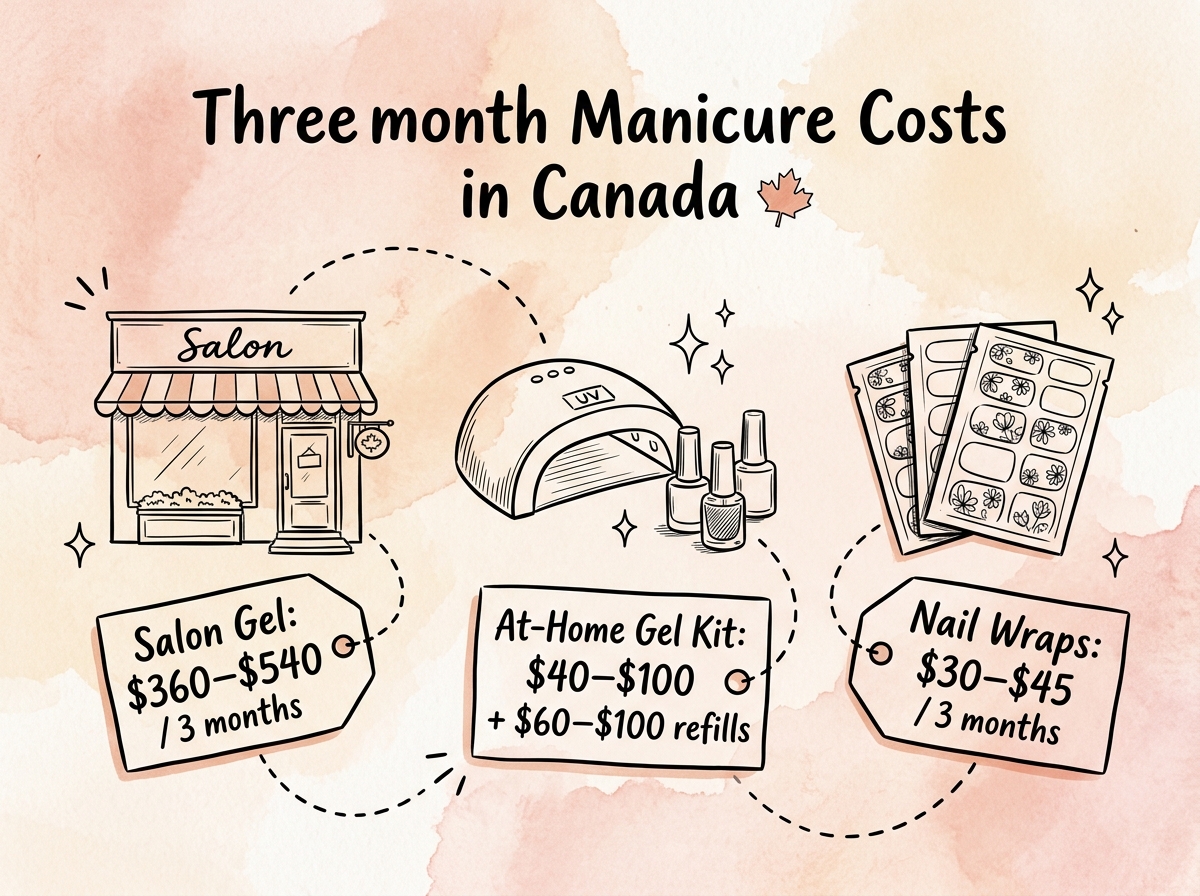
Nail wraps cost roughly one-fifth of a Canadian salon gel manicure when you calculate cost per wear. A salon gel service in Toronto, Vancouver, or Montreal runs $45 to $75 plus 15-20% tip, putting a single visit at $55 to $90. Removal isn't included — soak-off adds another $10 to $20 on your next visit, or you do it yourself with acetone.
At-home gel kits look cheaper upfront but require investment. A starter kit with a LED lamp, base, top, and two colors costs $40 to $100, and you'll keep buying replacement bottles every few months. Quality gel polish bottles run $8 to $25 each in Canada.
ManicureFX nail wraps from Nailwraps.ca cost roughly $10 to $15 per set, and most packs include enough wraps for two full manicures because you get more strips than you have nails. No lamp, no base coat, no top coat required.
Run the math over three months. Bi-weekly salon gel: roughly $360 to $540 plus tips. At-home gel after the kit purchase: about $60 to $100 in refills. Bi-weekly nail wraps with two manicures per pack: $30 to $45 total. Even if you only get 7 to 10 days per wrap set versus 14 to 21 for gel, the per-wear cost still favors wraps by a wide margin.
Which is easier to apply at home for beginners?
Nail wraps are significantly easier for beginners, taking 10 to 15 minutes with no tools beyond a nail file. You clean the nail, peel a wrap off the backing, stretch it to fit, smooth it down, file off the excess at the tip, and move to the next finger. No drying, no waiting, no smudging.
Gel polish is a multi-step process with real failure modes. You need a clean nail, a dehydrator or alcohol wipe, base coat (cure 30-60 seconds), two color coats (cure between each), and top coat (final cure). Total time runs 45 minutes to over an hour for a first-time at-home attempt. Common beginner mistakes include flooding the cuticles with polish (causes immediate lifting), uneven coats that show streaks, under-curing that leaves the surface tacky, and curing too long which can cause heat spikes painful enough to make you yank your hand out of the lamp.
Wraps also solve a sizing problem that gel doesn't have. Each ManicureFX set includes multiple widths, and the material stretches to conform to wide, narrow, short, or long nail beds. Designs like Sweet Trouble or Night Sky fit thumb to pinky from the same pack.
The biggest practical win: zero dry time. You can apply wraps five minutes before walking out the door. With gel, even fully cured polish stays vulnerable to dents from the inhibition layer until you wipe it down properly.
Which option is worse for your natural nails?
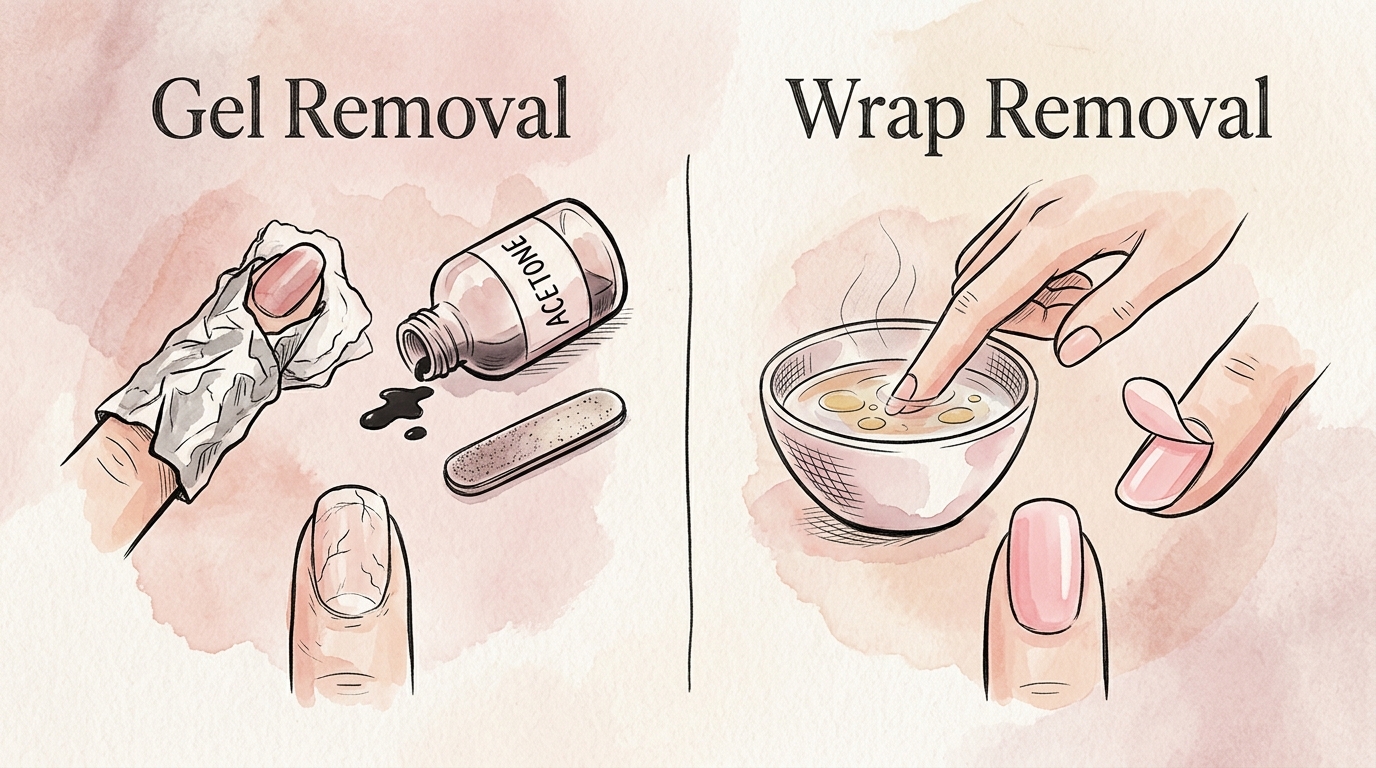
Gel polish causes more cumulative damage to natural nails than wraps, mostly because of how it's removed rather than how it's worn. Standard gel removal requires wrapping each finger in acetone-soaked cotton and foil for 10 to 15 minutes, then scraping off the softened gel. Most people — and many salon techs — file or buff the surface first to break the top coat seal, which thins the nail plate every single time.
Dermatologists at the American Academy of Dermatology recommend taking breaks between gel manicures specifically because of this cycle. Repeated acetone exposure also dries the surrounding skin and cuticles, leading to peeling and brittleness.
UV exposure is the second concern. A 2023 study from UC San Diego found that UV nail lamps can damage skin cell DNA with repeated use. The risk is low per session but cumulative over years of bi-weekly appointments.
Nail wraps remove without any of this. Soak your fingertips in warm water with a few drops of oil for 5 to 10 minutes, and the wraps peel off cleanly. No acetone, no scraping, no filing the nail plate. Because ManicureFX wraps are formulated with real nail polish ingredients, your nails breathe between applications the same way they would after regular polish — no thick gel shell, no chemical bond to break.
If your nails are already thin from years of gel, wraps like Morning Mist are a low-impact way to keep wearing color while your natural nails recover.
When should you choose nail wraps over gel polish?
Choose nail wraps when speed, design variety, budget, or nail health matter more than maximum wear time. Specific scenarios where wraps win clearly:
Travel and last-minute events. No drying time means you can apply a set in the airport bathroom or 10 minutes before a dinner. A set like Angelic Accents takes less time than waiting for a single coat of regular polish to dry.
Frequent design changes. If you like switching looks every week, gel's longer wear is wasted on you — you'd be removing it before it even fails. Wraps let you wear Fiery Foliage one week and Bright Galaxy the next without acetone in between.
Sensitive or recovering nails. If you've taken a break from gel because of peeling or thinning, wraps give you color and pattern without setting recovery back.
Budget-conscious manicures. Under $15 per pack with two manicures' worth of wraps inside beats any salon option in Canada.
Design range. Florals, French tips, glitter, ombre, abstract — patterns that would take a skilled nail tech 45+ minutes are pre-printed on wraps.
Gel still wins for very specific situations: a 3-week vacation where you can't reapply, a wedding where you need bulletproof wear through dancing and dish-rinsing, or very long nails where the gel shell adds structural reinforcement.
Where can you buy quality nail wraps in Canada?
For Canadian buyers, Nailwraps.ca ships ManicureFX wraps from a Canadian warehouse, which means no customs fees, no border delays, and no waiting 2 to 3 weeks for U.S. shipments. Most orders arrive within standard Canada Post timelines.
ManicureFX wraps are made with real nail polish ingredients rather than the cheap PVC plastic used in many drugstore options, which is why they last 7 to 10 days instead of peeling off in 3. The catalog covers French tips like Cinnamon Milk, florals like Enchanted Garden, glitter sets like Glitter Dip, ombre styles, and abstract designs.
Nailwraps.ca also offers a lowest price guarantee, so you're not paying a premium for the Canadian warehouse convenience. Every set fits all nail sizes from thumb to pinky, and the application process is the same regardless of design.
Key Takeaways
- Nail wraps last 7-10 days; salon gel polish lasts 14-21 days when applied correctly.
- Wraps apply in 15 minutes with no lamp; gel takes 45+ minutes plus UV curing.
- Canadian salon gel costs $45-$75 per visit; ManicureFX wraps run $10-$15 per pack.
- Gel removal requires acetone soaking and filing that thins the nail plate over time.
- Choose wraps for travel, weekly design changes, sensitive nails, and budgets under $15.
Frequently Asked Questions
Do nail wraps last as long as gel polish?
No, not quite. Quality nail wraps like ManicureFX last 7 to 10 days, while properly applied salon gel polish lasts 14 to 21 days. The gap closes if you compare wraps to at-home gel applied by a beginner, which often fails by day 10 due to lifting or chipping. For most people changing designs weekly, the wrap lifespan is actually a feature, not a drawback.
Can you put gel top coat over nail wraps?
Yes, applying a gel top coat over standard nail wraps can extend wear by 5 to 7 days and add a glossy finish. You'll need a UV or LED lamp to cure it. If you want the gel-wrap combination without buying both products, ManicureFX offers dedicated gel nail wraps like Mint Whisper that are formulated for lamp curing from the start.
Do nail wraps ruin your natural nails?
No. Nail wraps are one of the gentlest manicure options available. They apply with adhesive rather than chemical bonding, and they remove with warm water and oil — no acetone, no filing, no buffing the nail plate. Compared to gel polish removal, which thins nails over repeated cycles, wraps cause essentially no structural damage to the natural nail.
How do you remove nail wraps without damage?
Soak your fingertips in warm water with a few drops of cuticle oil or olive oil for 5 to 10 minutes. The adhesive softens, and the wraps peel off cleanly from the cuticle edge. Never rip them off dry — that can pull up layers of the nail plate. If a wrap resists, soak longer rather than forcing it.
Are nail wraps cheaper than getting gel at a salon?
Significantly cheaper. A salon gel manicure in Canada costs $45 to $75 plus tip, with $10 to $20 more for removal. A ManicureFX wrap set costs $10 to $15 and often includes enough strips for two full manicures. Over three months of bi-weekly manicures, you'd spend roughly $30 to $45 on wraps versus $360 to $540 on salon gel.
Can nail wraps get wet right after application?
Yes, but it's smart to wait about an hour before submerging your hands in hot water or dish soap. Brief contact with water — washing your hands, splashing your face — is fine immediately. Avoiding hot baths, long showers, and dishwashing for the first 24 hours helps the adhesive fully set and adds days of wear.
Do nail wraps work on short or wide nails?
Yes. ManicureFX wraps come in multiple widths per pack and stretch to conform to short, wide, narrow, or long nail beds. You simply pick the strip closest to your nail width, press it on, and file off any excess at the tip. Every pack fits thumb to pinky on the same person, so sizing isn't a barrier.